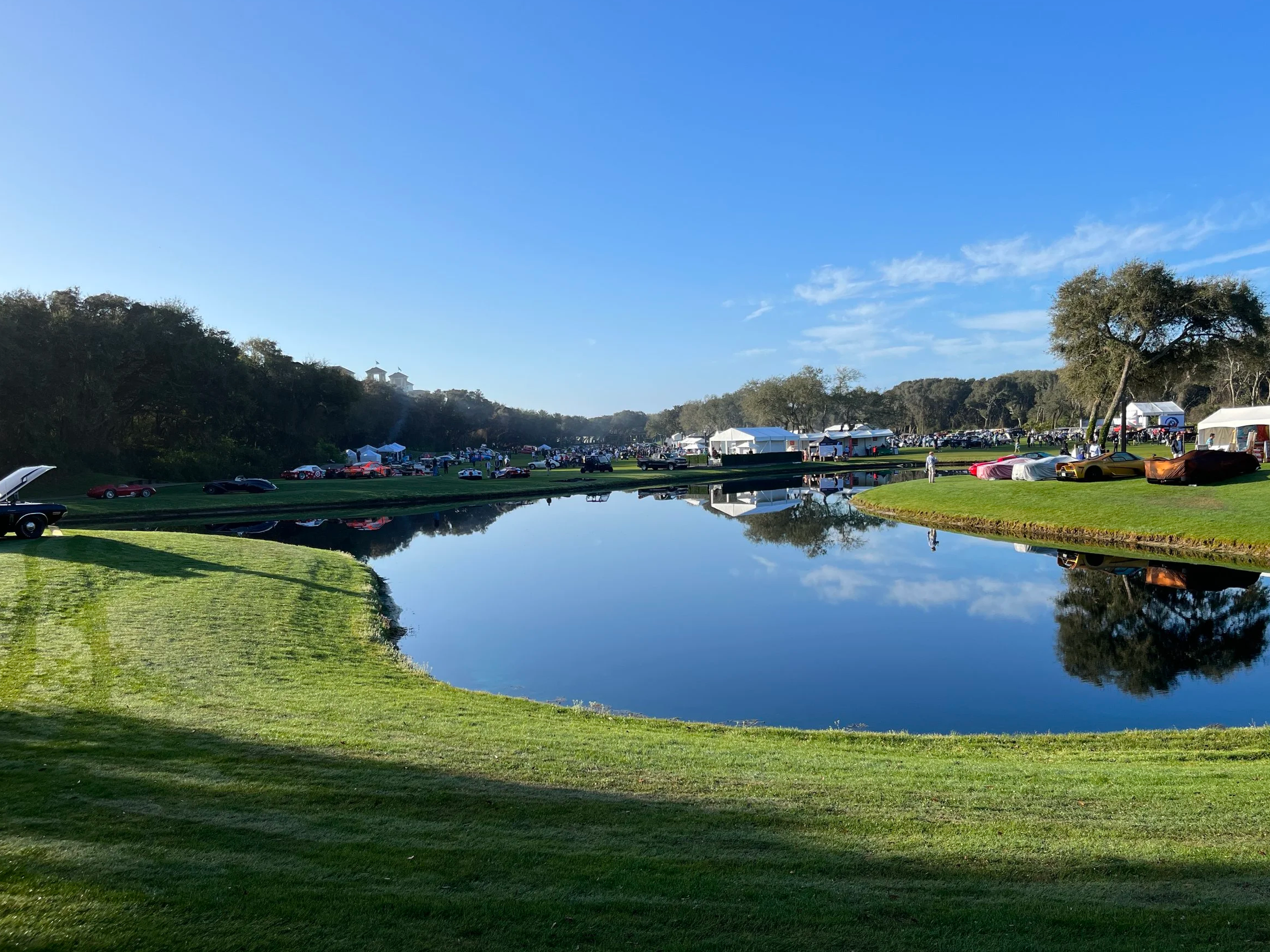
The Amelia Island Concours d’Elegance - Florida
The Amelia Concours d’Elegance - renamed The Amelia following Hagerty acquisition - has long been synonymous with strong auction results for pre‑war automobiles. However, this year played out a little differently: while the concours continued to honor automotive tradition, its official auction (Broad Arrow Auctions - part of Hagerty) increasingly reflects the market’s fascination with post‑1990s supercars, rare specifications, and virtually untouched modern icons.
On one side of the market, the traditional pillars of collecting were still standing. Over at Gooding & Company, the only other auction house still hosting a sale at Amelia, a spectacular Ferrari 250 GT SWB California Spider, sold for just over $16 million, making it the most expensive car of the weekend to cross the block. Meanwhile on the concours field itself, the highest honor went not to a mid-century icon or a modern hypercar, but to a pre-war masterpiece, a 1931 Duesenberg Model J ‘Tapertail’ Speedster by Weymann.
And yet, just a few steps away inside Broad Arrow Auction room, it is the youngtimers and modern supercars collectors were chasing. Over the course of the weekend, several icons of the analog supercar era crossed the block with remarkable results and records set. A Ferrari Enzo brought $15,185,000, confirming the trend seen at Mecum earlier this year; a (not so) One-of-One Porsche Carrera GT traded hands for roughly $6,700,000 and a Porsche 959 Sport pushed just beyond $5,500,000.
At first glance, the explanation seems straightforward. These machines belong to what many enthusiasts now describe as the “last analog generation” - cars defined by naturally aspirated engines, manual gearboxes, and minimal electronic intervention. But if the Amelia auctions proved anything, it’s that the youngtimer and contemporary supercar market is far more complex than a simple “analog equals valuable” narrative.
Because while the analog heroes performed exceptionally well, so did cars that represents something very different like the the Ferrari F12tdf selling for $4,185,000 or the Ferrari Monza SP2 selling for $4,955,000. Those are unmistakably modern supercars packed with electronics, advanced aerodynamics, and layers of software working constantly in the background. It is not necessarily analog machines in the romantic sense collectors like to celebrate. What this reveals is that the rush toward post-1990 supercars is not driven solely by mechanical purity. It is also fueled by what has quietly become one of the most powerful forces in the collector world: the obsession with specification and mileage, which is a dynamic that is playing out across an entire generation of modern supercars.
One could argue that the demographic shift helps to explain it. The collectors moving into the upper tiers of the market today are often people who grew up in the 1990s and early 2000s. For them, posters of the Carrera GT, the F40, and the Enzo were not historical artifacts, but contemporary dream cars, and now those same enthusiasts have the financial ability to buy them.
While Broad Arrow Auctions was busy demonstrating just how strong the market has become for post-1990 supercars and modern collectibles, the Concours Field and Gooding & Company reminded everyone that the traditional hierarchy of car collecting remains very much alive. Two different realities that made this year’s Amelia weekend so interesting.
A 1960s Ferrari roadster still topped the Sales. A pre-war automobile still won the Concours.
In other words, the collector car universe is not moving in a single direction. The blue-chip classics remain the cultural and historical backbone of the hobby. But just beneath them, an entirely different ecosystem is continuing to grow - one where early-2000s supercars, low-mileage youngtimers, and ultra-specific configurations are the new objects of obsession, fueled by a new class of buyers that are more impulsive and prone to buy the object more than the car.
And just like the great classics before them, they now face the same paradox: the more valuable they become, the less likely they are to be used for what they were originally built to do…
2026 Amelia Island Auctions Data
Broad Arrow Auctions - 92% Sell-through; $111,000,000 sold
Gooding Christie’s - 94% Sell-through; $71,797,800 sold
God Save the Wheels
