Something has been quietly shifting in the collector car market, and I am not sure enough people are talking about it.
Walk through the auction results from the last eighteen months and the headline numbers are hard to argue with. Auction and online sales hit $4.8 billion in 2025, up 10% on the year before. Seven-figure sales exceeded $1 billion in total for the first time ever. A Ferrari Enzo crossed the block in January 2026 for $17.875 million - roughly double what most of us would have called market value not long ago, as I wrote about here a few weeks ago. A Carrera GT sold in Miami in February for $6.7 million. A LaFerrari changed hands for $6.88 million. The '90s and 2000s supercar segment is performing at a level that would have seemed absurd five years ago.
The numbers are real. But I have been in enough auction rooms to know that numbers alone do not tell you who is actually in the room - or why.
The price of a car nobody is driving
Let me ask a simple question. When a Ferrari Enzo sells for $17 million, who buys it?
In many cases the answer, increasingly, is: someone who will sell it again. Not in ten years. Sometimes in ten months.
The collector car market has always had dealers. It has always had traders. That is not new and it is not inherently problematic - liquidity requires intermediaries, and good dealers bring genuine expertise and access to the market. But what I am observing more and more, particularly at the top end of the '90s-2000s supercar segment, is something different: a market where dealers are primarily buying from other dealers, where the same cars are rotating through the same rooms with increasing frequency, and where each rotation seems to add another zero to the ask.
This is not a collector market. This is a trading market wearing a collector market's clothes.
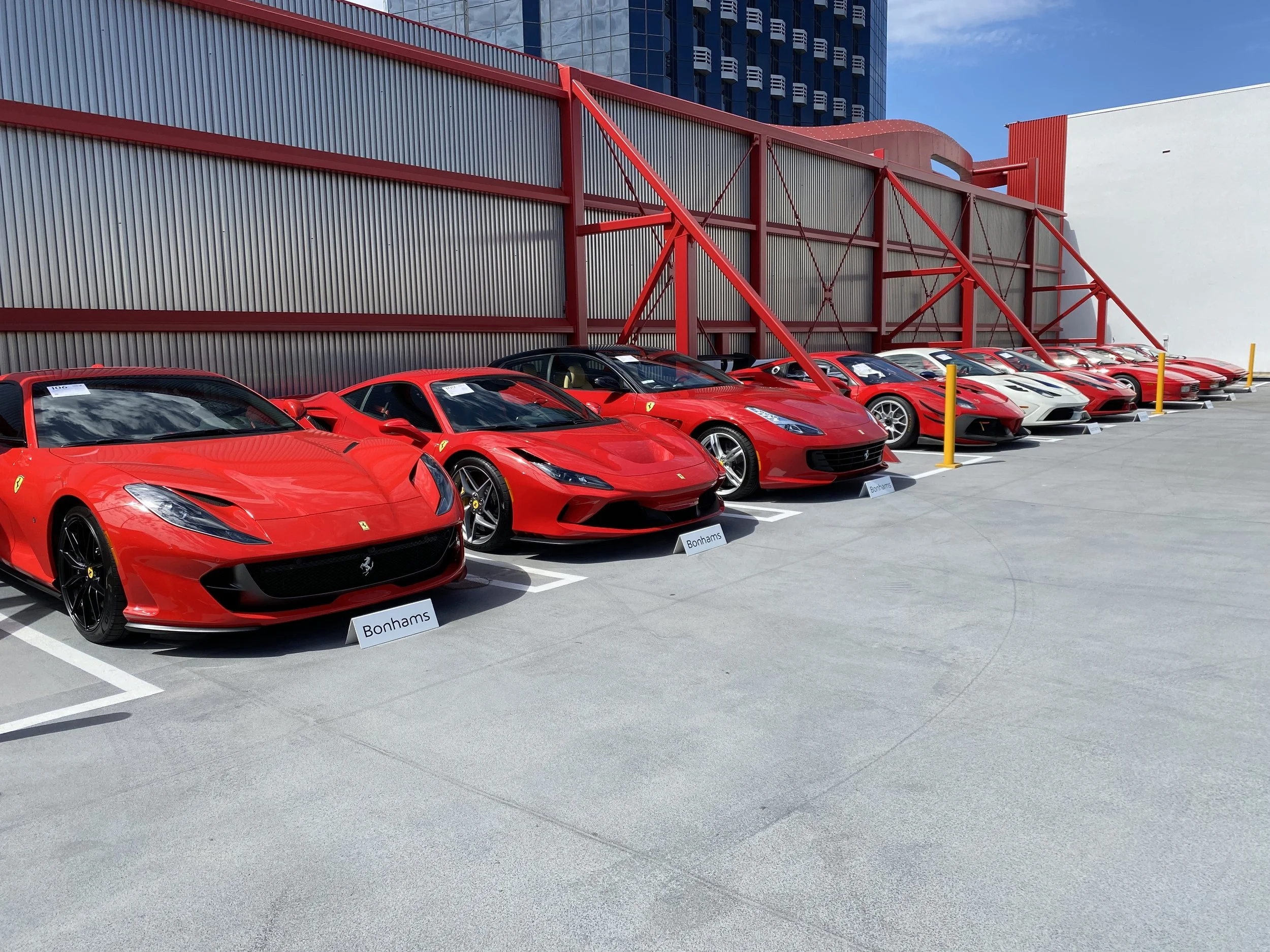
Ferrari line-up at the Bonhams auction ‘Supercars on Sunset’ held at the Petersen Museum in 2021.
The data underneath the headlines
Peel back the headline numbers and some things become harder to explain.
The Hagerty Market Index - a broad measure of collector car values - has been declining almost continuously since its peak in late 2022, recovering in only five of the past thirty-six months. The broadly held collector car segment has been falling steadily and is expected to soften further in 2026. The overall sell-through rate at auctions has been down although the start of 2026 has shown healthier numbers on that front. Overall, fewer cars are selling, but the ones that do are selling for more.
What that tells you is that the market is not broadly healthy. It is narrowly spectacular. A small number of cars at the very top - almost exclusively post-1990 supercars - are producing record results, while the vast middle and lower segments of the market quietly soften. The rooms making headlines are the same rooms where, three rows back, perfectly good cars are passing through with barely a paddle raised.
Two-thirds of the market is cooling. One-third is on fire. And that one third is exactly where the trading activity is concentrated.
When speculation money arrives, it rarely comes alone
There is another data point worth sitting with. Speculation money has been arriving in the hypercar segment with increasing frequency - and it is now being deployed on cars that have not even been built yet. RM Sotheby's sold a Gordon Murray Special Vehicles S1 LM - a future build, a car that exists primarily as a promise - for $20.6 million. The car is not finished. The buyer is not a car person waiting to drive it. The buyer is someone betting that the next person in the chain will pay more.
That is not collecting. That is futures trading with nicer brochures.
And as with any market that turns speculative, the money does not arrive alone. Financing follows. Specialty lenders have been quietly expanding their presence in the collector car space - offering loans of up to $2 million on classic and exotic vehicles, with terms stretching to fifteen years. Total US vehicle debt has grown by more than 56% over the past decade, and while the collector car segment represents a fraction of that, the direction is the same. When borrowed money starts chasing scarce assets, it does not simply participate in price appreciation - it accelerates it. The buyer who could not afford $3 million cash can suddenly afford the monthly payment on $3 million financed. The ask goes up accordingly.
It is worth remembering that this is exactly how most speculative cycles in asset markets have unfolded historically. Prices rise. Financing becomes available. More buyers enter. Prices rise further. The financing looks increasingly reasonable relative to the new higher price. Repeat, until the music stops.
The red flags a careful buyer should watch
None of this means the market is about to collapse. The wealthy buyer remains insulated from broader economic pressures. Supercar prices at the top end are partly driven by genuine scarcity - there will only ever be 1,311 Ferrari F40s, 1,654 Ferrari Enzos, 1,270 Porsche Carrera GTs. The "last analog generation" narrative is real and emotionally powerful. These are objectively extraordinary machines.
But there are patterns that should make any serious buyer cautious.
When the same car appears at auction multiple times in a short window, that is worth noting. When a car's provenance trail leads back through a succession of dealers rather than long-term private owners, that is worth noting. When a model's average sale price doubles in three years without any fundamental change in supply, rarity, or historical significance - just enthusiasm and momentum - that is worth noting.
Markets driven by enthusiasm and momentum are not the same as markets driven by value. They tend to look identical on the way up. The difference only becomes visible when someone decides to exit and discovers that the next buyer is not there at the price they expected.
Are we at peak speculation?
I would not call it a crash waiting to happen. The buyers at the very top are wealthy enough and patient enough to hold, and genuine enthusiasm for these cars is real and generationally broad. The '90s and 2000s supercar moment is not manufactured - it reflects something true about a generation coming into wealth with vivid memories of exactly these machines.
But I do think we are in a phase where price and value have quietly separated for a meaningful portion of the market. Where the volume of dealer-to-dealer activity has inflated reference prices beyond what organic collector demand can currently sustain. Where a correction - not a crash, but a correction - would not be surprising, and would not be irrational.
The cars that will hold value through whatever comes next are the ones bought for the right reasons, with the right history, at the right entry point. The ones bought because the next person in the chain would pay more are the ones that tend to find their way back to the auction floor.
And when they do, everyone in the room already knows who bought them - and why.
God Save the Wheels
